
Philippine Books

Philippine Selection
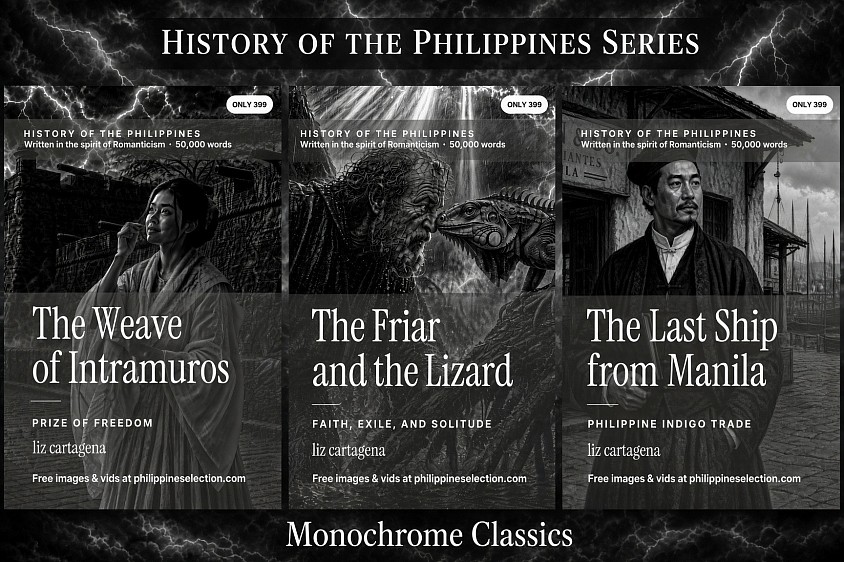
In the humid dawns of the Philippine archipelago, where the monsoon still carries the brine of the Pacific and the incense of newly raised crosses, the Spanish crown first claimed the islands not by unbroken conquest but by fragile compact, fragile faith, and the stubborn navigation of men who read the stars as both map and judgment. The novels of the Philippine Selection return to those centuries—chiefly the mid-sixteenth to early seventeenth—when the galleon route bound Manila to Acapulco, when Augustinian friars walked the same trails as soldiers and merchants, and when Chinese traders, Visayan datus, and Castilian captains shared harbors that smelled equally of copra, gunpowder, and wet earth after rain. These books do not treat the islands as a distant stage for European drama. They inhabit the moment when the City of God and the City of Man collided in the same plaza, the same rice field, the same confession. Readers move among the decks of Legazpi’s ships, the unfinished walls of Intramuros, the workshops of Sangley craftsmen, and the coastal villages where older spirits had not yet yielded. The prose keeps the weather, the texture of piña cloth under the hand, the sudden silence after a cannon’s report, and the private doubts that official chronicles omitted. Faith appears as both shelter and burden; loyalty as both oath and calculation; the Pacific itself as a character that grants passage one season and withholds it the next. What emerges is less a chronicle of arrival than a sustained attention to the human cost and consequence of that arrival—on those who came, those who received them, and those who were already there. The Philippine Selection gathers these narratives so that the archipelago’s early colonial decades can be read not as prologue but as the dense, unfinished present of people who lived them.